Old habits die hard — but they do die
We analyzed what thousands of people actually track when breaking their oldest, hardest habits. Here's what we found — backed by neuroscience.
Why Your Old Habit Keeps Coming Back
It's not a willpower problem. It's a brain wiring problem. Here's what the science says.
Your brain never erases an old habit
MIT's Ann Graybiel proved habit neural patterns stay dormant in the basal ganglia — even after you stop. One trigger reactivates the exact same pattern.
Graybiel, Nature Reviews Neuroscience, 2005
Willpower fails under stress
Schwabe & Wolf proved stress flips a neural switch from goal-directed to habitual behavior. Under cortisol, you revert to old patterns automatically.
Schwabe & Wolf, Journal of Neuroscience, 2009
Nearly half your day is automatic
Wendy Wood (USC) found ~43% of daily actions are habitual — same time, same context, no conscious thought. Your old habit is one of them.
Wood et al., J. Personality and Social Psychology, 2002
Forget the '21 days' myth
Phillippa Lally (UCL) found breaking a habit takes 18 to 254 days — median 66. The '21 days' claim has zero empirical basis.
Lally et al., European J. Social Psychology, 2010
The 10 Old Habits People Are Actually Breaking Right Now
Ranked by how many people track them. Each backed by specific research.
Smoking & Vaping
The classic old habit. One of the hardest physical addictions to break — but every smoke-free day rewires the pattern.
The average smoker needs ~30 quit attempts before succeeding. But after 2 years clean, relapse drops to just 2–4% per year.
Chaiton et al., BMJ Open, 2016
Junk Food & Unhealthy Eating
Comfort food is wired into childhood memories. It starts early, runs deep, and fights back when you're stressed.
People who track their food daily lose twice as much weight as those who don't. Tracking changes behavior — not calories.
Kaiser Permanente / NIH, 2008
Alcohol
Woven into culture, social life, and stress relief. For many, this old habit means years or decades of patterns.
63% of all alcohol is consumed Thursday through Saturday. Know your danger days — they're predictable.
Del Boca et al., J. Studies on Alcohol
Excessive Screen Time
Only 10–15 years old as a habit, but already deeply ingrained. The phone has become a compulsion, not a tool.
The average person checks their phone 205 times per day — every 5 minutes while awake. That's not a choice. That's a circuit.
Reviews.org, 2024
Sugar & Soda Addiction
The sneaky old habit. Most people don't realize sugar is a habit until they try to stop — and feel the withdrawal.
In lab studies, 94% of rats chose sugar over cocaine. Your sugar craving is neurochemistry, not weakness.
Lenoir et al., PLOS ONE, 2007
Compulsive Digital Behaviors
One of the most tracked habits globally. The WHO formally recognized it. Often started young, deeply ingrained.
72% report withdrawal-like symptoms upon stopping. The most common relapse trigger: boredom combined with being alone with a device.
International Sex Survey, 42 countries
Skipping Exercise
The silent old habit. Being sedentary is the default — and defaults are hard to override without a visible streak.
The old habit of doing nothing always wins — unless you make the streak visible. 67% of gym memberships go unused.
Smart Health Clubs, 2025
Poor Sleep Habits
Staying up late is a habit that builds from teenage years. It wrecks everything else — energy, mood, willpower.
Your brain's natural clock runs ~24.2 hours — it literally wants to stay up late. Fixing this old habit takes weeks of consistent tracking.
CDC / Sleep Foundation
Overspending & Impulse Buying
People don't think of spending as a habit until the credit card bill arrives. But the pattern is there — same triggers, same response.
Self-monitoring creates a 'pause' that interrupts the automatic habit loop. Track your spending-free days and watch the pattern emerge.
Harkin et al., Psychological Bulletin, 2016
Weed & THC
Often dismissed as harmless. But no social pressure to quit means fewer support systems — making it quietly one of the hardest to break.
No one tells you to quit weed. That makes it harder, not easier. A streak counter becomes your accountability partner.
Knowing Your Old Habit Isn't the Hard Part
Everyone knows their old habit. That's not the problem.
The problem: you don't know your pattern. What day of the week? What time? What triggers it?
A meta-analysis of 138 studies (N=19,951) found self-monitoring is the #1 most effective behavior change technique.
Harkin et al., Psychological Bulletin, 2016
Not willpower. Not motivation. Not "just stop." Tracking.
People who track daily lose twice as much weight. Losing a streak hurts ~2x more than gaining a day feels good. And when you do slip, you see exactly when — so you can prepare next time.
One Tap to Start. Zero Effort to Keep Going.
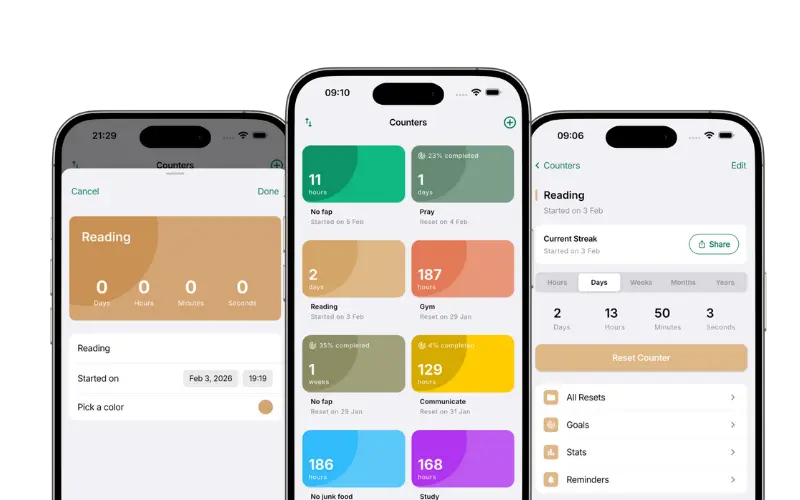
Countiful makes tracking effortless — so the science works for you, not against you.
Auto Day Counter
Set it once. It counts every day, hour, minute since you stopped. Zero manual effort.
Streak Awareness
See your longest streak. When you reset, see exactly when — and spot the pattern.
Daily Reminders
A gentle nudge to keep going. Not annoying — just 'Day 47. Keep going.'
Works Everywhere
iPhone, Mac, Apple Watch, Android, and Web. Your streak follows you across all devices.
Frequently Asked Questions About Old Habits
Your Old Habit Has Had Its Last Day
Start counting the days. For free. Right now.